News
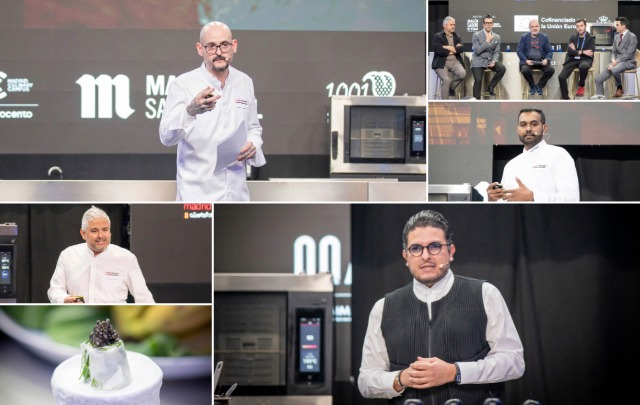
The sixth edition of the Madrid Fusión Alimentos de España wine congress gets underway
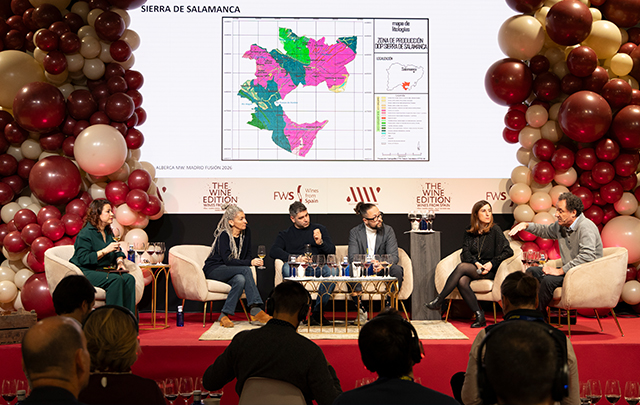
Benjamín Lana, Director General of Madrid Fusión, opened the sixth edition of The Wine Edition Wines from Spain with a clear objective: ‘We are trying to break down all the walls that we wine lovers are unintentionally putting up; we must continue working to win people back and make the world of wine more open and social’.
On the first morning of the conference, Master of Wine Almudena Alberca brought together five leading winemakers on stage to talk about slate terroir: Sara Pérez (Priorat), César Márquez (Bierzo), Fernando Mora MW (Calatayud), Maite Sánchez (Cebreros), and Fernando Maíllo (Salamanca).
In this masterful tasting, the conversation revolved around the characteristics of slate terroir and its impact on both vineyard cultivation and the organoleptic profile of wines. ‘The soil is one of the factors that most affects the organoleptic characteristics of the final wine’, Alberca pointed out. ‘That's why today we're going to talk about slate’.
The Spanish Master of Wine sought to find the essence of slate in wines through different varieties, areas, and production methods. ‘There are very different types of slate, but the important thing in Priorat is the fracture of the terrain, because this determines whether water is retained or not, or whether other sediments can enter’, pointed out Sara Pérez, head of Mas Martinet.
For his part, César Márquez pointed out the richness of the soils in El Bierzo and how this is reflected in the complexity of the wines. ‘Our slate soils are found on slopes at altitudes of 600 metres and above, in the form of rock covered with decomposed and encrusted slate; in these soils, white varieties play a fundamental role alongside Mencía because they soften the rusticity’, he said.
‘In Gredos, we are surrounded by granite soils. The slate area is small, but it manages to concentrate the grapes more and give the wines that ferrous touch that characterises these terroirs’, said Maite Sánchez, oenologist at Bodegas Arrayán.
Fernando Maíllo surprised attendees with a white Rufete Serrano, a rare native variety from the Salamanca mountains. ‘The consequence of the slate soil being so poor is that fermentation is very slow and we have to work more with the lees to produce more glyceric wines’, explained the winemaker.
From Aragón, Fernando Mora MW showcased the mineral and saline nature of the soils of Calatayud, where slate is mixed with other types of terroir, with a unique old vine Grenache from Bodegas Frontonio.
The ageing potential that these soils give to the wines, as well as the quality of rainy vintages, were another of the benefits of slate terroir highlighted by the speakers.
Wine as a catalyst for emotions
Ferran Centelles continued the morning with the theoretical session ‘Wine as an essential part of the customer experience’, in which the author of Bullipedia presented Volume VIII of Sapiens del Vino.
‘Wine is not just an accompaniment, it is an element that can transform the entire restaurant experience’, explained the former sommelier at elBulli. In this presentation, Centelles explained the research carried out, and the main ideas that help to understand how wine participates in the creation of value, emotion and memory in the diner.
From choosing the right glass to sell more wine to managing space and organising tables, prioritising reservations and reducing waiting times, this new volume of Bullipedia aims to help restaurants adapt to customer tastes and optimise their resources.
To support his participation and add a liquid touch to this masterclass, the sommelier served the attendees two unique wines that have surprised him in recent months, and which, in some way, represent the current revolution in the world of wine in contrast to consumer perception: an Airén aged on lees from Garage Wine, in Quintanar de la Orden (Toledo), and a 2009 red from Bodegas Buezo, in Arlanza.
‘Customers have many preconceptions before tasting wine, such as the idea that Airén grapes do not make good wines’, he explained. Every detail counts when seeking to enhance the customer's sensory journey. ‘Among the things we have discovered while writing this book, is the issue of noise and how it can influence the gastronomic experience and the perception of wine’.
To conclude his presentation, Centelles invited sommeliers to explain wine from an emotional perspective: ‘When we use this language, we touch the amygdala and increase dopamine, and studies show that we feel more pleasure. If we want to motivate customers to enjoy themselves, we must humbly show that we know what we are talking about’.
The colour of aromas
Monday morning came to an end with François Chartier's pairing tasting: from the aromatic DNA of wines, to gastronomic DNA. What if aromas had colours? ‘It is not a visual colour but a mental one, which our brain translates from our perception of that aroma’, argued the expert. ‘Pairing is not a recipe: it is a grammar that can be smelled’.
In this masterclass, the world's leading authority on aromas presented the results of studies that will be published in his 30th book for the first time. He explained how to identify the aromatic DNA of Spanish wines, and how to transform it into gastronomic DNA through his aromatic science of molecular harmonies.
Using a selection of great Spanish wines with unique DNA (from Tenerife to Mallorca, via Galicia, Aragon, Catalonia, and Jerez) and ingredients that share their dominant aromatic molecules, Chartier showed how wine can interact with food at a molecular level. A live demonstration that offered sommeliers and chefs a clear, structured, and applicable method for creating more coherent, precise, and memorable pairings and recipes.
Spanish wines in the Philippines
Chele González, the first Spanish Michelin-starred chef in the Philippines, presented a pairing during the first Vinomio 60 of The Wine Edition Wines from Spain, that fused cuisine rooted in local products with some of the Spanish wines that have conquered Asia’s most discerning markets.
With the invaluable help of Paula Menéndez, from In Wine Veritas, the Cantabrian chef explored how elevated Garnachas, high-altitude Godellos, and Mediterranean reds adapt to Japanese, Chinese and Korean palates, proof of the global reach of Spanish wine.
‘Spanish wines are part of the concept behind my projects, the basis of that concept of tapas with a Filipino flavour that characterises my cuisine’, he said.
‘There is a wide range of Spanish wines available in the Philippines, and the market is growing because consumers are looking for something different’, said Paula Menéndez. According to the data presented during the talk, Filipinos drink more red than white wine (75% compared to 25%), mostly light reds with low tannins.
For his part, Chele González acknowledged that ‘people in the Philippines eat less, are more conscious about quantities and health, and the market demands that prices do not rise, or even fall, while for us all the ingredients are becoming more expensive’. The solution, the chef confessed, has been to reduce portion sizes: ‘Smaller dishes, more affordable prices’. A win-win situation.
Blind chefs
In the early afternoon, Benjamín Lana and Alberto Fernández Bombín captured the attention of the numerous attendees at the open auditorium of The Wine Edition Wines from Spain with six pairs of international chefs, including Spaniards Andoni Luis Aduriz, Josep Roca and Iván Cerdeño, who became impromptu contestants in a blind tasting.
The Top Tasting thus became a serious game: a series of wines served without clues, forcing the chefs to hone their taste memory, intuition, and discourse around what they were drinking, ‘pressured’ by the participation of the audience.
‘Wine must be taken seriously, but with a smile’, concluded Lana. The entertaining session proposed an open dialogue between cuisine and wine, where each glass was interpreted, questioned and defended aloud, revealing how chefs think and feel when wine ceases to be an accompaniment and becomes the protagonist.
Collaborative wineries
To end Monday's session, Pilar Cavero (wine critic for ABC) presented other wine business models: cooperative work, micro-wineries, nomadic producers, and coworking, accompanied by Núria Renom, from the winery of the same name; Òscar Navas, from La Furtiva and Batussa; and Iván Gómez, from Bodegas Gratias.
A round table discussion on cooperativism, wine co-working and the recovery of spaces and techniques. How cooperation works when it comes to making wine, how the recovery of spaces and techniques affects artisanal production, and the importance of sharing tools, materials, and ideas. What happens when you don't have any backing, no family, no tradition, no structure, but you want to start a business in the world of wine? asked Pilar Cavero to begin the presentation. Òscar Navas, in Terra Alta, was fortunate to be sponsored by friendly wineries in his early years, thanks to which he was later able to set up a project that encourages collaborative production.
‘It's like sharing a flat, there are decisions you can't make as you would like, but there is another part of the community that is very beautiful’, he said.
Núria Renom's case is different. She was born in Buenos Aires and now lives and works in a shared winery in Penedés, where all the producers share the same natural philosophy: ‘There are as many ways of understanding wine as there are of understanding life, and it's very interesting to find those other perspectives, those other models of understanding the economy’.
Wine changed when we stopped talking about wineries and started talking about people, Cavero recalled. People with names and surnames, like those who bring Bodegas Gratias in La Manchuela to life, which operates through crowdfunding. ‘We started in our garage, then moved to a shared winery, and then to working with old vines of abandoned varieties’, said Iván Gómez.
The way to save these vineyards was to get more people involved, people who become patrons, and receive the wine once it has been made. ‘It's a very dynamic model, a product line that has practically overtaken the one we started with’.
In other sectors, such as music or art, collaborations are the order of the day, but in the world of wine, they are harder to come by. For these brave souls, working with other enthusiasts is not a necessity, it is a way of life that speaks of craftsmanship, freedom and unconditional love shared for wine. ‘Our model will never be based on competition, but on alliance, because production is very limited’, Renom pointed out.
As reflected in the presentation, the collaborative philosophy and natural wine go hand in hand. For the head of Bodegas Gratias, ‘natural wine is more than just with or without sulphites; it is territory, recovering history, varieties, learning from winegrowers, enjoying with friends, and making people happy with what they do’. Defending the beauty of humanity.
Related news
News
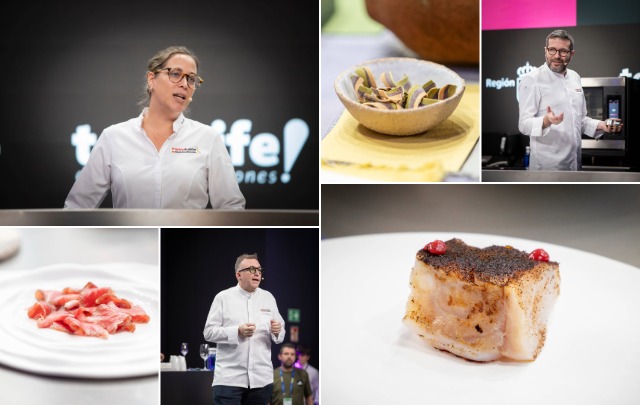
Madrid Fusión Alimentos de España relaunches its leadership as a comprehensive meeting platform for the international gastronomic community
News
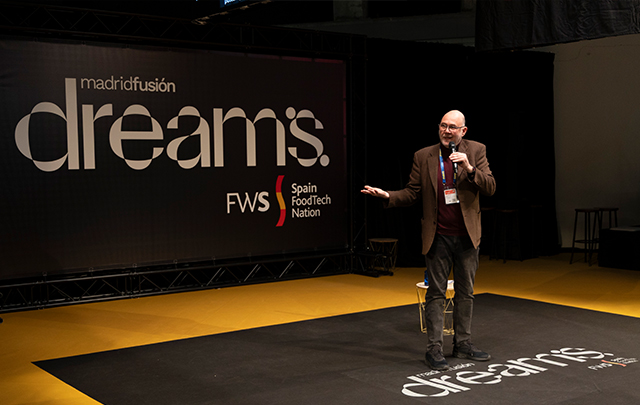
Toni Massanés: ‘The cuisine of tomorrow will be sustainable or it will not be
‘We spend more than two hours a day on TikTok and we can't find two minutes to make a parsley omelette’, laments the creator of the Alicia Foundation
News
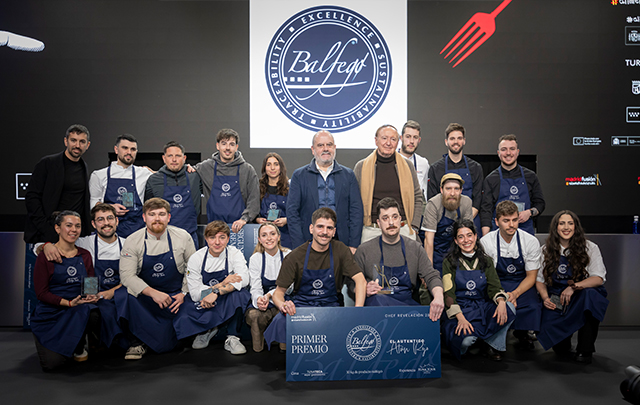
Javier Ochoa and Garikoitz Arruabarrena (Masta Taberna) win the Revelation Chef award for their haute cuisine without pretensions
News
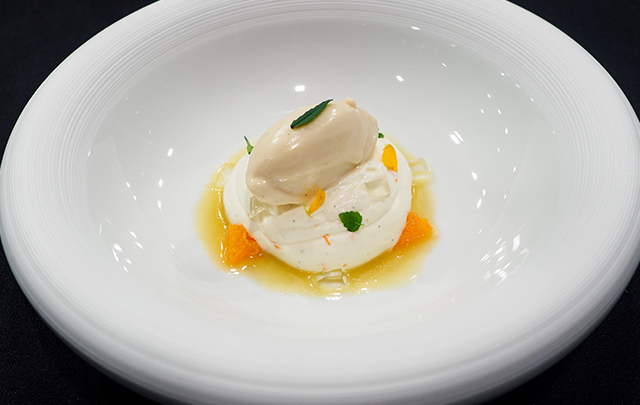
A Christmas-inspired dessert wins the Revelation Pastry Chef Award
Miguel Yeste, from the Madrid bakery Obrar, wins the coveted Madrid Fusión award
News
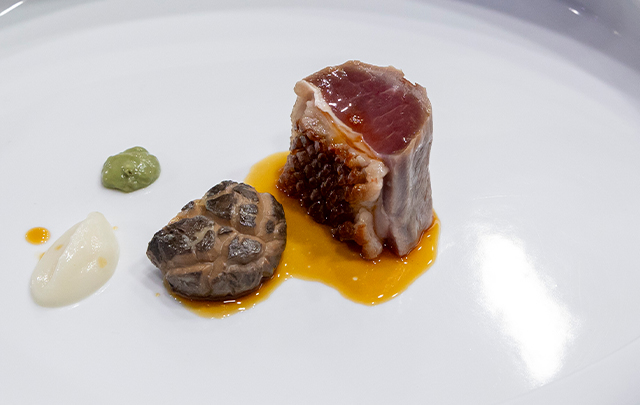
Good kilometre product
Madrid, the Neapolitan countryside, and the Philippines are stops on a gastronomic journey in which the protagonists focus on quality and relationships, rather than distance from the source
News
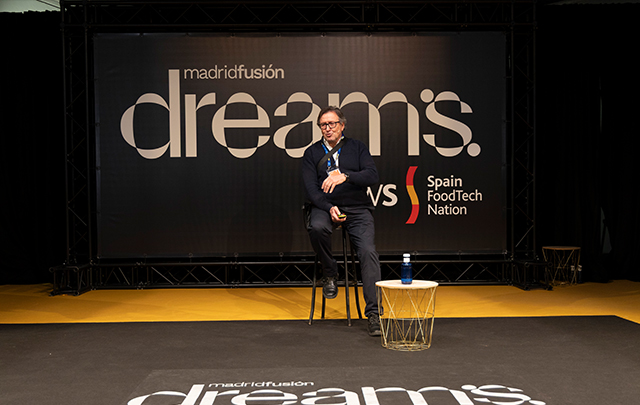
‘Salt and human health’: Science and the marine diet
Carlos Duarte reviews the millennial role of salt in well-being, health, and the economy for thousands of years at Dreams in Madrid Fusión
News
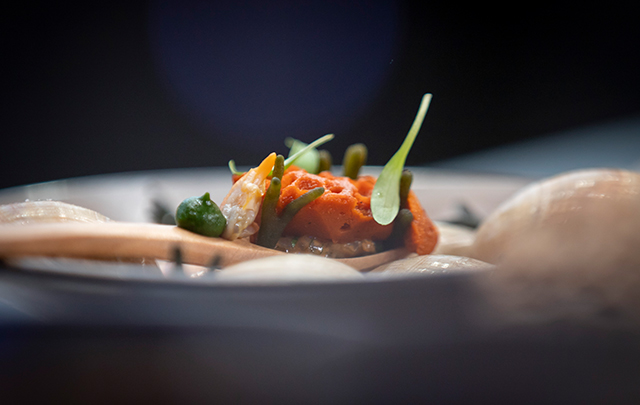
A philosophy inspired by nature
Gil Fernandes' cuisine, nestled between cliffs and forests, draws on local produce that the chef gathers with his own hands
News
All the flavours of Peru on one table
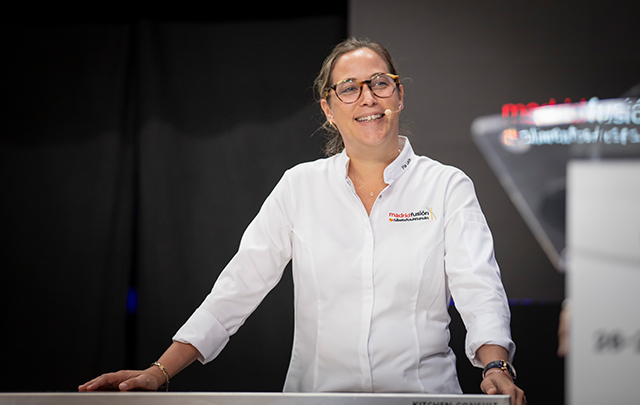
Chef Pía León researches the uses of little-explored ingredients, which she also uses not only for cooking in her restaurant Kjolle
News
Genetic vertigo to create the food of the future
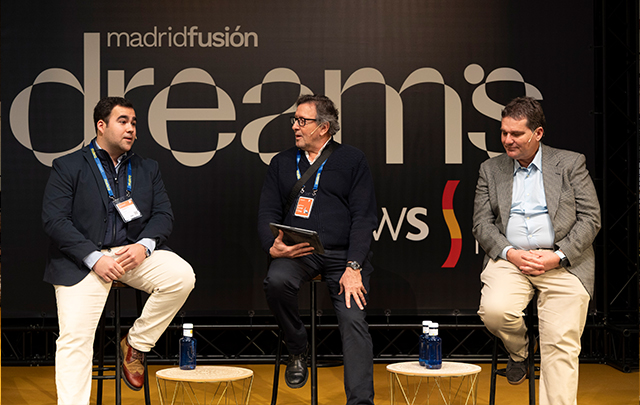
José Miguel Mulet, Professor of Biochemistry and Molecular Biology at the Polytechnic University of Valencia, speaks about genetic modification applied to food in the Dreams section of Madrid Fusión
News