News
The author's touch across very different latitudes
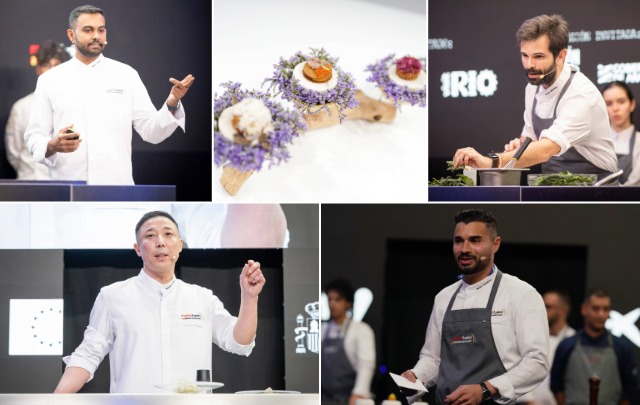
Madrid Fusión takes us across three continents, to bring us five very different visions of cuisine in which produce, technique, and roots always play a leading role
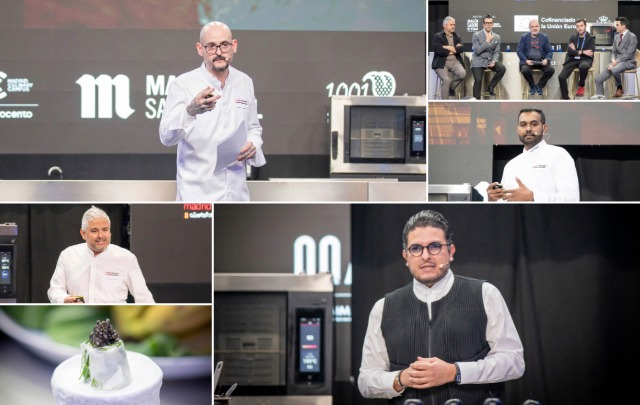
The second afternoon at the Madrid Fusión Auditorium began in Toyama Prefecture, Japan, before moving on to Singapore. After a stop in Madrid, it took us back to Buenos Aires, and ended in Tenerife. Three continents, five chefs, and as many perspectives on a cuisine in which technique, through very different formulas, always seeks to respect the product and the environment, consequently recovering its roots.
Oriental tradition
Tomohiko Kuchiiwa (Kuchiiwa Soba Restaurant, Toyama, Japan) was responsible for opening Tuesday afternoon at the Madrid Fusión Auditorium. He did so with “Soba in Japan”, a talk in which he revealed the secrets of the type of buckwheat that features prominently on his menu and which he himself cultivates in a very specific environment.
This was Kuchiiwa's first trip outside Japan, and he did so to share a popular, ancient culture, a very humble food that can be elevated to excellence. ‘For me, it is the most important ingredient, but it is also the one that inspires customers the most’, he explained. For this reason, he believes that the best way to try soba is in noodles with extra virgin olive oil (Australian) and salt from the Añana Valley, in Álava (‘I have tried 37 types of salt and this is the one that best suits soba’, he explained): ‘We serve delicious food, but we also give customers time and freedom to enjoy it and wonder about its aromas and textures. Soba tastes like our land, our origins, and we want diners to feel that’.
The roots, in every dish
From Japan to Singapore, to listen to Mano Thevar (Thevar**, Singapore) and his presentation “The soul of my heritage, served through food”. His Malay and Indian roots, his European training, and his Japanese influence form an interesting blend that Thevar brings to each recipe: ‘You could say that at Thevar I do a modern reinterpretation of Indian cuisine’. He seeks to work with spices that have medicinal properties and are treated in ways that differ from the more traditional formulas, without forgetting that feeling of community, of sharing with family, that these kitchens always foster. ‘Food is also about feelings and memories, and there are dishes that transport you back to your childhood’, he said, referring to one of the recipes he prepared live.
Regarding the diner who takes the lead, Thevar said that ‘customers are our judges, they evaluate us, and are the unifying element that allows us to use spices from different cuisines’.
Stop in Madrid
Coco Montes (Pabú*, Madrid) played at home with his “Green Creativity”. Montes creates micro-seasonal haute cuisine using a technique that serves a product that varies daily (like his menu and three set menus), because it adapts almost exclusively to what his three producers and suppliers bring him each morning. His obsession with freshness and his audacity earned him a Michelin star in just one year.
Immediacy and freshness are two constants in a cuisine that has reached the Auditorium through three reformulated sauces (an infused coconut milk, a beurre blanc with dried hibiscus and vanilla, and a pesto) that accompanied three dishes that had never been made before, highlighting his ingenuity in this apparent improvisation: ‘We are against having everything defined because it blocks creativity. It's vital to improvise a little because it allows us to go further than we could if everything were so planned. It's fun to let yourself go so that the customer can enjoy it’.
Precisely by focusing on the customer, he stated that ‘we try to ensure that when a diner sits down at Pabú, they find ingredients they know, but have fun like never before’.
Thus, ‘our constant effort is to satisfy the diner, merging with them without the cuisine losing its identity. Understanding that the diner helps us every day, is there for us, is where the future of restaurants lies’.
Offal brought to haute cuisine
Dante Liporace, from the Liniers Market (Buenos Aires, Argentina) and Dantte (Madrid), spoke about “Casquería de las pampas” (Offal from the pampas). A disciple of Ferran Adrià, after shifting from avant-garde extremism to haute cuisine that is an evolution of tavern food, he now seeks to recover the identity of Argentine cuisine, which has been excessively influenced by Spanish and Italian cooking.
‘We took the grill and the bodegones and fused them, adding all the technique and freedom that Spain and Adrià had given us, forming the new Argentine cuisine. Looking back at what immigrants used when they arrived in Argentina, we rescued offal, those parts and cuts that had been lost over the years, and brought them into haute cuisine’, he explained, always speaking in the plural. The result is that ‘Argentina is no longer purely a grill country, and today we have a much more interesting cuisine than we did years ago, with a hell of a lot of technique that we apply above all to meat’, Seafood, of course, is also becoming increasingly important, even sharing the plate with beef offal.
Pastry as a starting point
“Donaire: no boundaries between sweet and savoury” was the title of the exhibition by Jesús Camacho (Donaire*, Costa Adeje, Santa Cruz de Tenerife), a “repostichef”; that is, a pastry chef turned chef. ‘When I took over the restaurant, I understood that the change had to be natural and organic, and I transferred the personality I had in pastry-making to the kitchen, applying techniques we already knew to products from the island’, he began. Everyone on his team is a pastry chef: ‘Pastry-making is part of our cuisine, it is integrated into it and balances it. We deconstruct in order to rebuild, but always with a pastry perspective’, he said by way of a statement of intent.
His presentation was a true display of techniques that play with the product and the diner, ‘putting all our love and know-how into it. We want to become a benchmark in pastry-making’, acknowledged Camacho, although his potential goes beyond the realm of sweet treats to bring sparkle to every bite. ‘Donaire is love for pastry and respect for a product, that of Tenerife, which we must care for and pamper. We choose the product, we respect it and we apply our pastry techniques with great care’, he concluded.
Related news
News
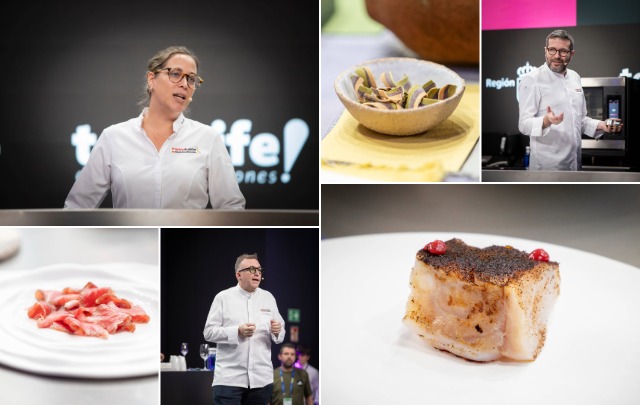
Madrid Fusión Alimentos de España relaunches its leadership as a comprehensive meeting platform for the international gastronomic community
News
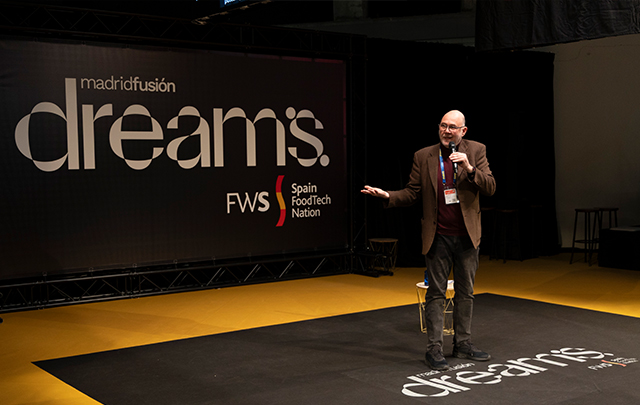
Toni Massanés: ‘The cuisine of tomorrow will be sustainable or it will not be
‘We spend more than two hours a day on TikTok and we can't find two minutes to make a parsley omelette’, laments the creator of the Alicia Foundation
News
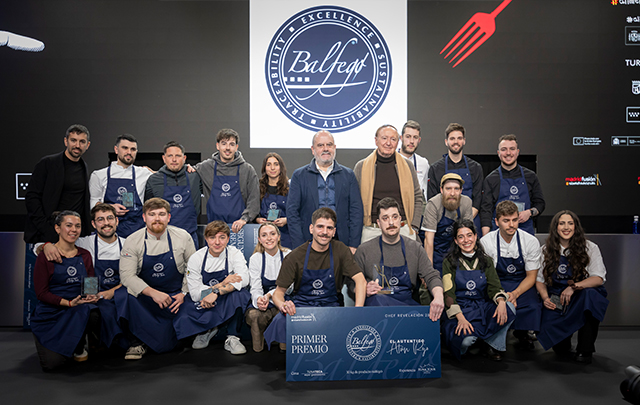
Javier Ochoa and Garikoitz Arruabarrena (Masta Taberna) win the Revelation Chef award for their haute cuisine without pretensions
News
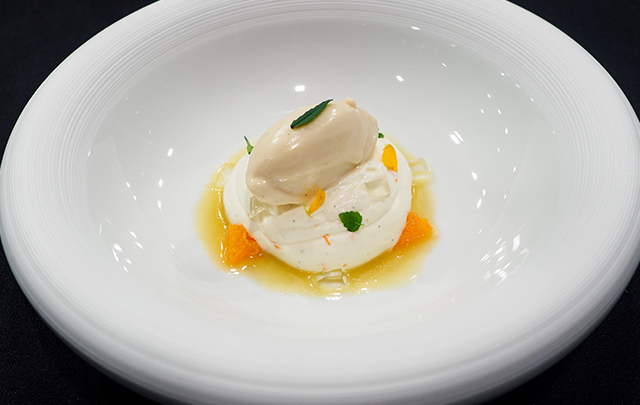
A Christmas-inspired dessert wins the Revelation Pastry Chef Award
Miguel Yeste, from the Madrid bakery Obrar, wins the coveted Madrid Fusión award
News
Good kilometre product
Madrid, the Neapolitan countryside, and the Philippines are stops on a gastronomic journey in which the protagonists focus on quality and relationships, rather than distance from the source
News
‘Salt and human health’: Science and the marine diet
Carlos Duarte reviews the millennial role of salt in well-being, health, and the economy for thousands of years at Dreams in Madrid Fusión
News
A philosophy inspired by nature
Gil Fernandes' cuisine, nestled between cliffs and forests, draws on local produce that the chef gathers with his own hands
News
All the flavours of Peru on one table
Chef Pía León researches the uses of little-explored ingredients, which she also uses not only for cooking in her restaurant Kjolle
News
Genetic vertigo to create the food of the future
José Miguel Mulet, Professor of Biochemistry and Molecular Biology at the Polytechnic University of Valencia, speaks about genetic modification applied to food in the Dreams section of Madrid Fusión
News