News
A cuisine that knows no eras, only times
Past, present, and future coexist in an auditorium where Aragón has presented a machine that, using micro-pulse technology, eliminates anisakis in microseconds
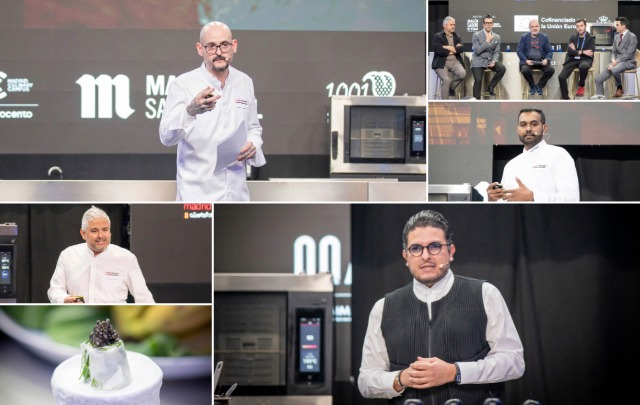
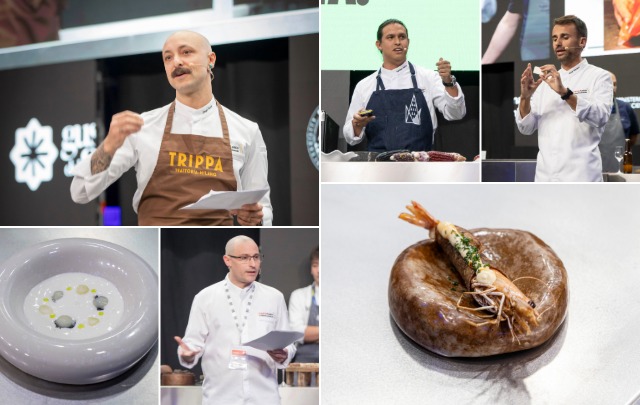
The presentation “Anachronistic Cuisine” by Cristian Palacio (Gente Rara*, Zaragoza), and sponsored by Aragón, the guest region at Madrid Fusión 2026, provided the context for the announcement of what José Carlos Capel, president of the congress, described as ‘a global bombshell, one of the milestones of this edition, which could change the lives of many people affected by a disease’.
The mystery was solved when they presented a machine that can kill anisakis without freezing the fish, created by the University of Zaragoza. Using a micro-pulse technique, tap water with salt is enough to selectively destroy the anisakis in microseconds without affecting the quality of the fish. Past, present, and future come together with this technique, and this meeting of the three has been a constant theme in the second part of this afternoon.
Time and care, non-negotiable
Before that announcement, Cristian Palacio and the Aragonese professionals, who surrounded him on stage, asked themselves what anachronistic cuisine is, what tradition is, what the future consists of, and what the avant-garde is and is not. ‘Today we can choose what to eat, but we should ask ourselves what we buy, where it comes from, how it has been raised and killed... That's where we are putting that moment of anachronism’, explained Palacio, to highlight the importance of seals of origin and quality.
His colleagues on stage also spoke about their commitment to rancio wines and their own local production, foie gras in cocktails, and the recovery of seeds that had fallen out of use. In any case, the reflection was similar, namely that seeking inspiration in the past can lead to finding formulas that are highly relevant today. The time and care they devote to each recipe, however, are always non-negotiable, as is the goal, which is none other than to reclaim their roots by recovering a legacy in the form of recipes.
Freedom to a certain extent
Diego Rossi (Trattoria Trippa, Milan) also spoke of the need to reconnect with the past, and with the customer. José Carlos Capel defined Rossi's approach to cooking as traditional Italian cuisine converted into modern cuisine and presented in a contemporary way. Rossi set aside haute cuisine to revive the trattoria formula, cooking ugly dishes so as not to take time away from the rich dishes.
‘I know how to plate up, but I choose not to waste time on embellishing dishes; I prefer to devote my time to flavour and consistency’, he explained. Rossi prepared a dish of tagliatelle with butter and Parmesan cheese, ‘the simplest of the entire conference’, after reviewing his career.
‘Identity is one of the key words in my thinking’, ‘I continued to cook in my dreams’, and ‘without mistakes there is no personal cuisine’, were some of the phrases that defined his concept of cooking.
He soon grew bored with fine dining and felt drawn to trattorias, ‘our original form of catering in Italy. With its popular soul and freedom, it had much more emotion’. A simple atmosphere, wooden tables, and honest cuisine would be the non-negotiable guidelines at Trippa, where Rossi began to use offal products, such as cow's fallopian tubes, or unusual vegetables that customers were unfamiliar with. ‘The technique was at the service of the ingredient, the real star’, he recalled. ‘We wanted to create culture, not money’, he added.
He believes that his business is ‘an example of how customers can relax, make their own decisions, and choose their dishes. They can go to the bathroom without having to give two minutes' notice. That doesn't mean we have to drop our trousers’, he said graphically.
Culture and gastronomy Santiago Muñoz Monteczuma, from the Maizajo restaurant (Mexico City), has become a champion of native corn and other local products. In two years, this informal and lively space has become a benchmark for Mexican cuisine. There, they nixtamalise corn daily to make it delicious and healthy, and this chef has focused his presentation on a technique they want to teach the world again.
Culture and gastronomy go hand in hand in the world of corn. ‘Like us, there are different types genetically speaking, but we are all the same’, he said, as a starting point for an educational journey around nixtamalisation, ‘my life today, but also very important for the world, because there are taquerías everywhere. It is a technique that adapts to the corn we have in each place, a process that makes corn digestible by the human body, but it is a method, and not a recipe’.
In 5,000 years of history of this technique, it has not been applied to other products, much to Muñoz Monteczuma's surprise. ‘Nixtamal is transformation and therefore gives us many possibilities’, he said with conviction. A community has been created around this technique, and a circular, sustainable, living formula has been sought that can travel: ‘The future is ancestral. Nixtamalisation must be an open door to the world and to food’, he concluded.
Cooking a territory
The curtain fell on the Auditorium after the presentation “The lactic power of whey: new flavours and textures of a territory” by Borja Marrero (Muxgo*, Las Palmas de Gran Canaria). The surplus obtained during cheese production can also have value in gastronomy, as Marrero sought to demonstrate. ‘Looking back is also moving forward’, he stated emphatically.
His presentation went much further, however: ‘We are in a very high territory, with very limited flora and fauna that we must take advantage of. And we have created a method that can be used in any other area that is also limited in terms of resources, where imagination must also be used’, he introduced. The fact is that ‘we want to cook an ecosystem’, he stated, as a declaration of intent. And he achieves this with very few products and a deep knowledge of techniques and processes, reflected both in the dishes he has created and in a method in which landscape and recipe connect seamlessly, through whey itself as well as aromatic herbs.
‘We make it clear that we use what we have, and the day we stop being creative, we will close the doors of Muxgo, happy with what we have done. It is all about focusing and seeing the goodness in each product’, he acknowledged. ‘When you understand the place you live in, the method comes naturally’, he concluded.
Related news
News
Madrid Fusión Alimentos de España relaunches its leadership as a comprehensive meeting platform for the international gastronomic community
News
Toni Massanés: ‘The cuisine of tomorrow will be sustainable or it will not be
‘We spend more than two hours a day on TikTok and we can't find two minutes to make a parsley omelette’, laments the creator of the Alicia Foundation
News
Javier Ochoa and Garikoitz Arruabarrena (Masta Taberna) win the Revelation Chef award for their haute cuisine without pretensions
News
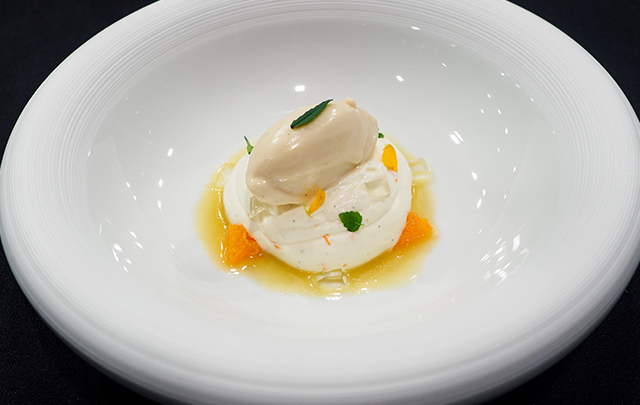
A Christmas-inspired dessert wins the Revelation Pastry Chef Award
Miguel Yeste, from the Madrid bakery Obrar, wins the coveted Madrid Fusión award
News
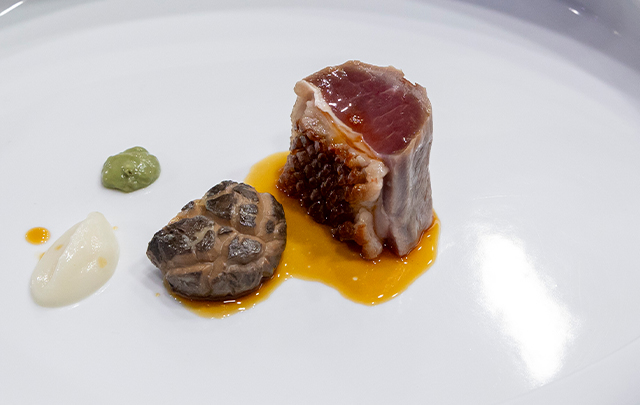
Good kilometre product
Madrid, the Neapolitan countryside, and the Philippines are stops on a gastronomic journey in which the protagonists focus on quality and relationships, rather than distance from the source
News
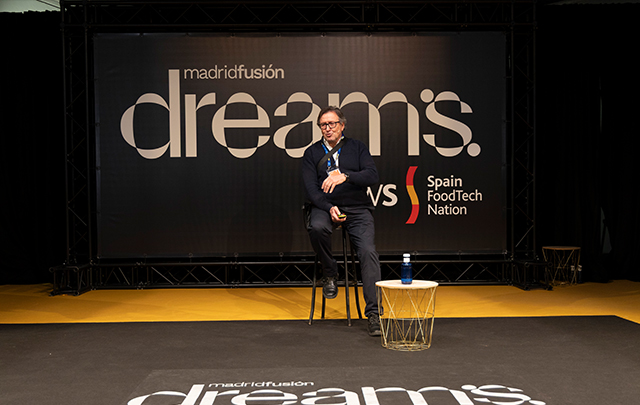
‘Salt and human health’: Science and the marine diet
Carlos Duarte reviews the millennial role of salt in well-being, health, and the economy for thousands of years at Dreams in Madrid Fusión
News
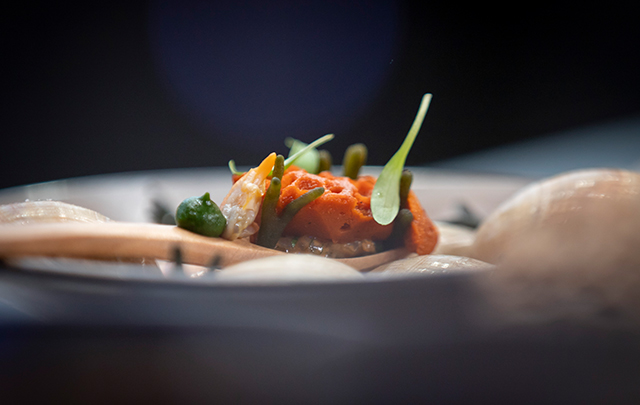
A philosophy inspired by nature
Gil Fernandes' cuisine, nestled between cliffs and forests, draws on local produce that the chef gathers with his own hands
News
All the flavours of Peru on one table
Chef Pía León researches the uses of little-explored ingredients, which she also uses not only for cooking in her restaurant Kjolle
News

Genetic vertigo to create the food of the future
José Miguel Mulet, Professor of Biochemistry and Molecular Biology at the Polytechnic University of Valencia, speaks about genetic modification applied to food in the Dreams section of Madrid Fusión
News